Regulator Fireside Chat….
The Future Of Travel and Travel Insurance As The World Emerges From COVID – Poll Results

Making Insurance Simple and Accessible for Canadians
Regulator Fireside Chat….
The Future Of Travel and Travel Insurance As The World Emerges From COVID – Poll Results
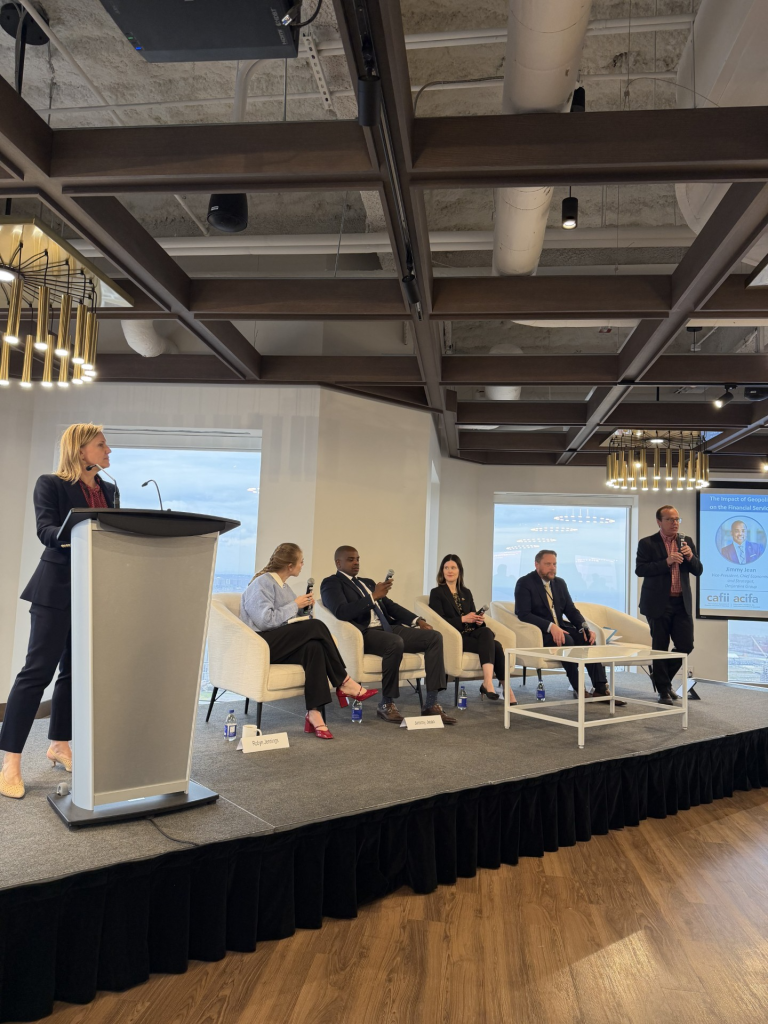
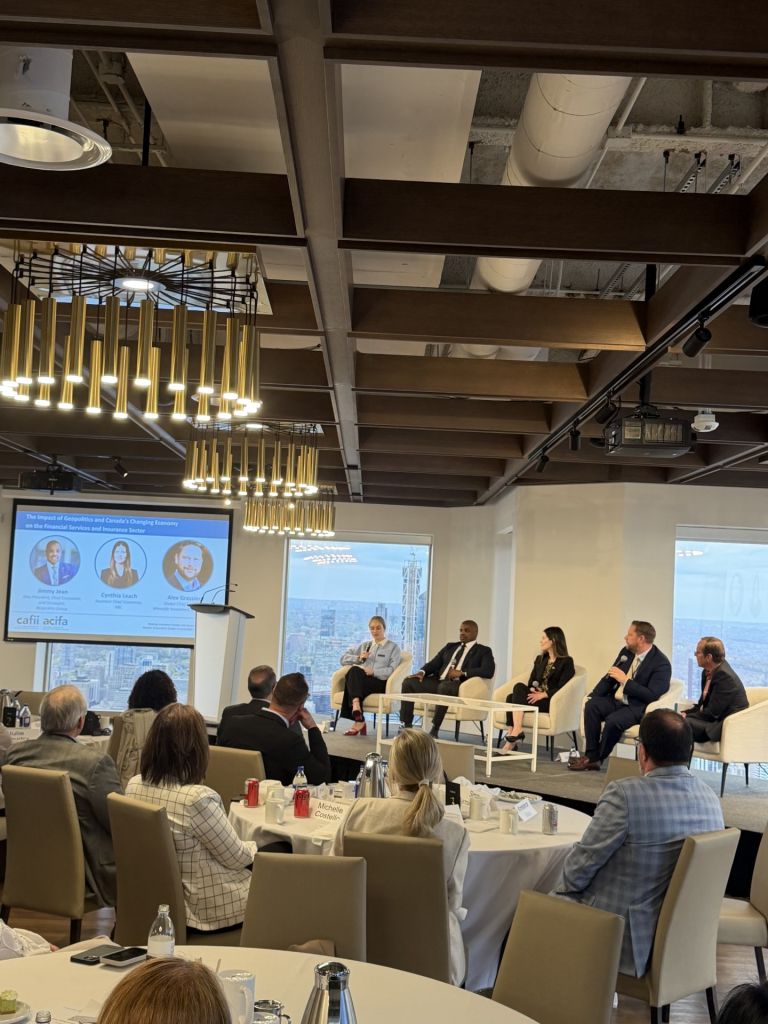
CAFII’s Annual Members Luncheon was held on May 5, 2026, at the beautiful facilities of SixtyEight in downtown Toronto. The luncheon included a panel discussion featuring three economists: Jimmy Jean, Vice President, Chief Economist, and Strategist at Desjardins Group; Cynthia Leach, Assistant Chief Economist at RBC; and Alex Grassino, Global Chief Economist at Manulife Investment Management. The speakers were introduced by CAFII Board Chair Val Gillis (SVP, TD Insurance) and thanked by incoming Board Chair Julie Gaudry (VP, RBC Insurance), and the panel was moderated by CAFII’s Executive Director, Keith Martin, and Senior Research and Policy Analyst, Robyn Jennings.
The conversation was fascinating, with the panel discussing the state of the Canadian economy, interest rate expectations, the risk of a recession, and geopolitical issues. The impact of the conflict in the Middle East on the Canadian economy was discussed, particularly inflation and rising gas prices. Population and demographic issues were also explored, including the increase in provincial health care budgets, which now account for over 50% of provincial budgets in most provinces. There was also discussion of mortgage trends and the impact of costs on the likelihood that people will not obtain optional insurance.


By Keith Martin, Executive Director, Canadian Association of Financial Institutions in Insurance (CAFII)
As Canadians begin planning spring and summer travel outside of their home province or territory, many travellers assume that the travel insurance coverages that are included in their credit card will provide all the protection they need.
Credit cards can offer valuable travel benefits, and many include insurance coverage benefits such as emergency travel medical, trip cancellation and lost or delayed baggage coverage. Standalone travel insurance may also be offered through a variety of channels, including financial institutions, insurance advisors, travel providers and online trip booking platforms. The details of coverage can vary depending on the policy and provider.
Travelling without insurance is risky, but so is assuming travel insurance coverage exits on a credit card without fully understanding what coverages are included, what exclusions may apply, what the duration of coverage is, etc. Not understanding the durations of the coverage provided by your credit card could result in you not having coverage during what would normally have been a covered event.
Many travellers rely on credit card coverage
Credit card travel insurance is convenient. For many cardholders, the coverage is automatically included as part of their credit card benefits, which means travellers may not need to purchase a separate policy if their trip is booked using the credit card that has those embedded travel coverages.
Depending on the credit card, coverage may include insurance that provides coverage for:
Because these coverages are included in the credit card, travellers may assume they provide comprehensive protection for any and all trips.
In reality, coverage may be more limited than many people expect.
Common limitations travellers may not realize
Credit card travel insurance policies, as with any insurance product, typically include conditions and limitations that affect when and how coverage applies.
For example, some policies require that the entirety of the trip be purchased with the credit card in order for certain benefits to apply. Others may limit coverage to trips of a specific length, such as 15 or 21 days. Also, a pre-existing exclusion may apply to medical conditions and/or symptoms that existed prior to your trip booking or departure.
Age limits may also apply. Some credit card travel insurance policies reduce or eliminate emergency medical coverage once travellers reach a certain age.
Coverage limits can also differ significantly from standalone travel insurance policies. While credit card coverage can provide meaningful protection.
This doesn’t mean credit card travel insurance benefits aren’t valuable. In many cases it provides meaningful protection and can help travellers manage unexpected financial risks during a trip. Understanding how the coverage works simply helps travellers determine whether it is adequate coverage for their travel specific plans.
Why reviewing coverage before travelling matters
Most trips proceed without major issues. But when unexpected events occur, such as illness, travel delays or trip cancellations, the financial consequences can quickly become significant.
Understanding what protection is in place before leaving home helps travellers avoid surprises later.
Here are some steps you could take:
As with any insurance product, reviewing the policy terms and coverage limits can help travellers understand whether the embedded travel insurance coverage provided with their credit card is adequate for their particular trip.
Protection starts with understanding your coverage
Credit card included travel insurance benefits can provide valuable protection and may be sufficient for many trips. But coverage varies from card to card, and assumptions about protection can sometimes lead to unexpected gaps.
Before travelling, understanding exactly what your included credit card travel insurance covers and where additional protection may be needed, is an important step in responsible travel planning.
For Canadians preparing for upcoming travel, the key question is simple: not just where you’re going, but what insurance coverage is in place to help financially protect you if something unexpected happens either before or during your trip.
By Keith Martin, Executive Director, Canadian Association of Financial Institutions in Insurance (CAFII)
Financial vulnerability isn’t just about payments — it’s about preparedness, clarity and understanding the insurance protection you actually have.
Interest rates dominate headlines for a reason. They affect monthly payments, budgets, and financial planning. But if you’re worried about mortgage stress, there’s a bigger question worth asking: What would happen if your income suddenly changed?
Rates matter. But resilience, your ability to manage an unexpected financial disruption — is often the factor that determines if a household weathers a challenge or faces serious strain.
Most conversations about mortgage pressure focus on numbers: interest rates, payment increases, renewal terms.
What often gets overlooked is the cushion behind those numbers.
Many Canadians are managing their finances carefully, but CAFII research shows that unexpected income loss would create difficulty for a large share of households. For some, it would take only a few months for a temporary setback to become a major financial issue.
That doesn’t mean people are irresponsible or unprepared. It reflects a reality many households share: rising costs, complex financial commitments, and limited room for surprises.
Financial resilience isn’t about predicting the future. It’s about understanding how prepared you are for it.
Life rarely changes on schedule. Illness, job transitions, caregiving responsibilities, or unexpected expenses can affect income at any time. When that happens, households don’t just rely on their income, they rely on:
The key word is understand.
In this context, “protection” refers to creditor insurance, which insures credit products, such as mortgage, loans, lines of credit or credit cards and is designed to pay down the outstanding balance if a covered event such as death, disability or critical illness occurs.
Understanding how this type of coverage works, including what events are covered and how benefits are applied, is an important part of financial preparedness.
One of the most important findings in CAFII’s research is that many Canadians feel confident in their financial protection but are less certain about the details.
Some people aren’t sure:
That gap doesn’t necessarily mean people lack protection. It means many haven’t had reason to look closely at it yet.
But when uncertainty rises, as it often does during periods of economic change, clarity becomes essential.
It’s easy to assume that financial vulnerability mainly affects households with limited earnings. In reality, financial pressure can affect a wide range of Canadians.
Even higher-income households may face strain if income changes suddenly, especially when they’re managing mortgages, credit obligations, family expenses, and long-term savings goals.
Financial resilience is less about how much you earn and more about how prepared you are for disruption.
When researchers look at what makes households more financially resilient, the answer is rarely a single product or decision. It’s usually a combination of factors, including:
In other words, financial resilience often comes from clarity rather than complexity.
If mortgage headlines have you thinking about your financial situation, you don’t need to overhaul your finances overnight. A few simple questions can provide valuable perspective:
These aren’t questions people ask every day. Understanding the answers can make a meaningful difference in how prepared you feel.
Interest rates rise and fall. Economic conditions shift. Headlines change.
Financial resilience is what helps households navigate those changes.
That’s why conversations about mortgage stress shouldn’t focus only on rates and income. They should also focus on preparedness, on understanding what protections exist, how they work, and how they fit into a broader financial picture.
CAFII is the Canadian Association of Financial Institutions in Insurance. We represent and promote financial institutions in insurance and work to support an open, competitive marketplace that gives consumers expanded choice and access to insurance products and services.
As Canada’s economic environment continues to evolve, CAFII believes clear consumer education and confidence-building must be central to the conversation.
Because mortgage stress isn’t just about interest rates.
It’s about financial resilience.
On January 29, 2026, CAFII hosted a webinar titled AI is here. Now What? An Operator’s Playbook for Unlearning and Relearning Insurance. CAFII’s Executive Director, Keith Martin, opened the session by thanking attendees and introducing CAFII’s Senior Research and Policy Analyst, Robyn Jennings, who in turn introduced the featured speaker, Tatenda Manjengwa, Executive Vice President of AI Strategy and Product Management within financial services.
Mr. Manjengwa is a recognized AI leader who transforms emerging capabilities into production-grade solutions in highly regulated environments. In his previous role as Managing Director, Head of BMO Wealth Management’s AI Innovation Lab, he drove enterprise-wide AI adoption across 5,000+ employees, launching Rovr AI, Canada’s first of its kind external-facing generative AI assistant for insurance underwriting, while establishing governance frameworks across BMO Private Wealth, Global Asset Management, Insurance, and InvestorLine. With 20+ years spanning capital markets and wealth management at BMO, Bloomberg, Citibank, and Deutsche Bank, Mr. Manjengwa operates at the intersection of AI product strategy, quantitative finance, and commercial innovation. He has led cross-functional teams of data scientists and engineers, deploying NLP- and AI-enabled workflows on secure, scalable multi-cloud platforms that improved client experience and reduced operating costs.
Mr. Manjengwa holds an MBA from Chicago Booth and an MSc in Business Analytics & AI from NYU Stern. A lifelong learner, he is currently pursuing his third master’s degree: an MS in Computer Science at Georgia Tech.
Following the introduction, R. Jennings extended a special welcome to several VIP guest attendees, including CAFII’s 14 member companies, 14 Associates, allied industry associations such as the Canadian Life and Health Insurance Association (CLHIA) and the Travel and Health Insurance Association of Canada (THIA), and representatives from various insurance and financial services regulators and policy-making authorities, including:
R. Jennings opened the discussion by asking T. Manjengwa to summarize the state of AI in financial services. He framed the moment in concrete terms: AI is here, but the work now is turning hype into hard-dollar outcomes. The industry’s task is shifting from experimentation to industrialization — from one-off pilots to a disciplined, scalable AI manufacturing line that reliably ships results, not just ideas. He characterized this as the move from AI-curious to AI-capable. The deeper question, he added, is not how to use AI to do what firms already do — but what becomes possible that was previously unthinkable, and whether organizations are building themselves to ask that question seriously.
Canada, he noted, has been punching above its weight: Manulife ranks fifth among the world’s 30 largest insurers in Evident’s global AI maturity index, and is one of only three firms to place in the top ten across every dimension measured. The opportunity is tangible; the question is whether organizations have built the factory to capture it.
T. Manjengwa clarified that when he refers to AI, he means actual machine learning models, including generative AI. He encouraged intentionality and discipline as organizations scale these technologies — moving from a small team of AI engineers familiar with the tools to embedding capability across every level of the business. That structural shift, he argued, will separate firms that lead from firms that stall.
R. Jennings asked how leaders can integrate AI into deeply embedded legacy systems. T. Manjengwa replied: “We are not prisoners of our legacy systems — we are prisoners of the ideas that brought us here.” These systems were built to support the financial institutions of a different era. They have served us, but the operating logic must change. He suggested a three-phase approach:
Asked what insurers must unlearn first, T. Manjengwa invoked Alvin Toffler’s line that the literate of the 21st century will be those who can learn, unlearn, and relearn — and was direct: AI is not a side conversation parallel to business — it is the business conversation. Three specific unlearnings followed: that AI is a technology problem to be solved by data scientists (it is an organizational transformation requiring workflow redesign and change management); that certainty must precede action (it must not, in environments this dynamic); and that pilot culture is sufficient (it is the trap most firms get stuck in). Digitization, he noted, fails when best-in-class tools are layered on top of analogue, redundant processes. Leaders must internalize that change management is not part of what they do — it is what they do. Deploy AI only to replicate existing workflows, he warned, and you risk scaling today’s constraints into tomorrow’s systems.
As much as we shape AI, it also shapes us.
On balancing risk-aversion with the need to experiment, T. Manjengwa was measured: being smart, methodical, and equipped with the right guardrails allows leaders to balance risk and innovation. Active engagement with regulators is essential — calibrating AI guardrails will require many participants. And firms must put the right people in the right seats; AI is complex, and capable, talented teams will make the difference.
On the qualities to hire for, he prioritized two: curiosity and humility. Curiosity drives experimentation and innovation; humility enables course correction when something is not working. Combined with a strong knowledge base, these traits enable an organization to learn, relearn, and unlearn at the pace the technology demands.
On regulatory governance, T. Manjengwa called for a shift from a posture of compliance-and-monitoring toward genuine co-creation between industry and regulators. Regulators will need deeper familiarity with business models to ensure rules promote responsible innovation rather than stifle it. He encouraged the same talent discipline on the regulatory side — the right people in the right roles.
R. Jennings raised the concern around AI replacing humans, asking where human judgment must permanently reside. T. Manjengwa responded that LLMs are probabilistic by design and require a human-in-the-loop, particularly when handling financial information and adverse decisions. Citing Satya Nadella’s recent comments at Davos, he noted that real value comes from grounding these models in firm-specific context — but that is one input, not the final answer. AI should be regarded as a tool to augment judgment, not replace it; offloading menial work — for example, summarizing a 60-page document — frees experts to focus on the complex, the contested, and the consequential. The deeper test, he suggested, is not what AI can do, but what we are willing to entrust to it — and, just as importantly, what we refuse to relinquish.
On work unbundling, T. Manjengwa explained that traditional roles are being decomposed into component tasks, with AI handling structured analysis while humans focus on judgment, relationships, and complex cases. He cited the recent McKinsey CEO framing of an organization with 40,000 humans and 25,000 agents — and the practical reality that managers will increasingly orchestrate both. The claims adjuster is illustrative: AI automates intake and damage estimation; the human is freed for disputed and complex matters. Jobs will not vanish, but they will evolve, and the skills firms recruit for must evolve with them.
The deeper shift, he suggested, is not in how insurers do the work but in what the work itself becomes. McKinsey has framed it as the move from “detect and fix” to “forecast and avert” — from a business that indemnifies losses after they occur to one that uses continuous intelligence to prevent them. Parametric products, real-time risk monitoring, prevention as a revenue line: these are not adjacencies to insurance; increasingly, they are what insurance is becoming. The unbundling of jobs is the operational symptom; the rebundling of the value proposition is the deeper event.
The corollary is a hiring redesign: the goal cannot be turning the next generation of professionals into mere exception-handlers. Roles must be designed around uniquely human skills — judgment, empathy, complex reasoning — paired with fluent AI use.
Asked who is responsible when AI makes or influences a bad decision, T. Manjengwa was clear: accountability sits with the team and the organization, not a single individual. Building interdisciplinary teams — business, regulatory, and technical expertise together — is what makes AI defensible. There will always be a chief analytics officer, but successes and failures should be read as collective. When AI succeeds, it is a team result; when it fails, the same logic applies.
On what firms owe their customers, he was unequivocal: full transparency on how data is used and where AI is involved. In financial services, disclosure is not optional.
R. Jennings asked why so many AI programs fail. T. Manjengwa pointed to MIT’s recent NANDA report finding that 95% of generative AI pilots produce no measurable P&L impact. The root cause is the execution model: teams chase flashy use cases rather than solving real business problems, and they try to do it without seasoned partners. The takeaway is twofold — solve a real business problem, and do not start from scratch. Working with vendors and consultants is a strength, not a weakness; he referenced the Rovr AI build at BMO, which leaned heavily on Microsoft, not for lack of internal talent but because the territory was new for everyone.
Closing the webinar, R. Jennings asked what would constitute evidence that an insurer has moved from AI-curious to AI-capable. T. Manjengwa pointed to several markers: a structured, rigorous implementation discipline that has evolved past use cases into a philosophy of continuous learning and experimentation; visible adoption metrics — Manulife, for instance, has reported a 75% adoption rate of AI tools across its workforce after years of systematic investment; and active regulator engagement. He flagged the regulatory horizon as well — OSFI’s Guideline E-23 on Model Risk Management takes effect May 1, 2027, and applies to all federally regulated financial institutions. The recent CAFII–Deloitte study, in which more than 60% of insurers expect AI to materially impact underwriting and claims, underscores why the move from curious to capable is now an industry-wide imperative.
T. Manjengwa concluded with a quote from John Schaar that reads “The future is not some place we are going, but one we are creating. The paths are not to be found, but made. And the activity of making them changes both the maker and the destination.” The work, he closed, is not merely to adopt tools but to align them to a clear aspiration for the kind of institutions this industry chooses to become. These are questions of identity, courage, and imagination — and the answers we choose will shape us long after today’s tools have changed.
By Keith Martin, Executive Director, Canadian Association of Financial Institutions in Insurance (CAFII)
Many Canadians believe they have enough protection in place to weather a financial shock. But new national research suggests that confidence may not always match reality.
As part of a new study commissioned by CAFII, Pollara Strategic Insights surveyed more than 3,000 mortgage and HELOC holders to understand how Canadians think about protection and how prepared they actually are. Across every age group, income level, and life stage, one theme emerged: many people feel confident, but most do not know how long their insurance coverage will last.
Several findings point to a disconnect between how protected Canadians feel and how protected they are:
Even among people who consider themselves financially secure, the study shows that unexpected income loss could cause significant strain.
The research highlights three key reasons many Canadians may feel more protected than they actually are.
This is particularly true for life insurance. Most homeowners believe they have adequate coverage, yet many don’t know how long that coverage would support their household.
A bigger pay cheque doesn’t automatically translate into stronger financial protection.
Understanding the confidence gap doesn’t mean that homeowners need more insurance. Instead, it highlights something more important:
Every Canadian deserves a clear picture of what protection they already have — and what risks might remain.
Real confidence comes from:
A few simple questions can help homeowners strengthen their financial resilience:
At CAFII, we believe that clarity is the foundation of confidence. Clear information about creditor insurance, including how it supports borrowers as credit obligations increase, helps Canadians better understand the role these products play in managing financial risk.
By Keith Martin, Executive Director, Canadian Association of Financial Institutions in Insurance (CAFII)
For many Canadians, owning a home represents stability, security and a step toward long-term financial wellbeing. But new national research shows that behind the scenes, a growing number of homeowners feel anything but secure.
CAFII partnered with Pollara Strategic Insights to survey more than 3,000 Canadians with a mortgage or a home equity line of credit (HELOC). The findings offer an important reality check on how prepared, or unprepared, many Canadian households are for a sudden change in income.
One of the clearest signals in the research is just how thin the financial margin is for many homeowners.
Half of those surveyed said they could only maintain their current lifestyle for less than six months if their primary income stopped. Half also said they would have serious problems paying their bills if the main income earner in their household could not work.
The survey suggests that a large number of Canadians are only a few disrupted paycheques away from difficult decisions about mortgage payments, credit card balances, groceries, or childcare.
Homeownership often comes with significant debt, but the study shows just how heavy these obligations are for many families:
With rising living costs, interest rate fluctuations and economic uncertainty, it’s no surprise that 44% of homeowners say current economic conditions are making their finances worse.
A key insight from the study is that financial vulnerability isn’t limited to those earning less.
Even homeowners with household incomes between $120,000 and $250,000 report similar pressures:
Higher income does not always translate into higher financial resilience. Many Canadians, regardless of income, are navigating the same financial uncertainties.
Perhaps the most concerning finding is the disconnect between homeowners’ concerns and their level of preparedness.
Many people fear the impact of a sudden job loss or illness, yet:
This lack of clarity increases stress and can leave families more exposed to risk than they realize.
While no one can predict the future, small, practical steps can help Canadians strengthen their financial safety net:
At CAFII, we believe that informed decision-making starts with clear, accessible information. Financial vulnerability isn’t a personal failing, it’s often the result of rising costs, unpredictable economic conditions and the realities of modern life.
By shining a light on these trends, the Pollara study aims to help Canadians better understand their situation, ask the right questions and feel more confident about protecting their households.
